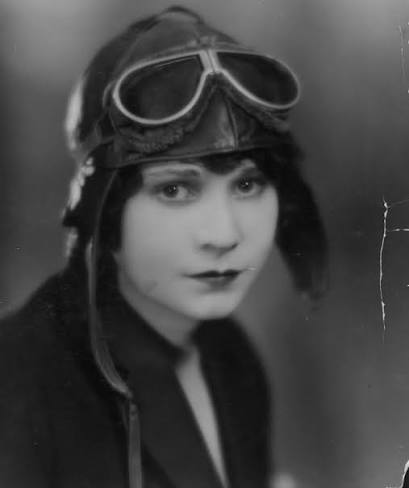
There was a time when aviation was still young, when airplanes were fragile machines of wood, fabric, and wire, and when the people who flew them were regarded with equal measures of admiration and disbelief. Flying itself was an extraordinary accomplishment. Yet for a remarkable group of men and women in the 1920s, simply remaining inside an airplane was not nearly exciting enough.
Among those daring performers was a young woman named Gladys Roy, whose willingness to climb out onto the wings of an airplane thousands of feet above the earth made her one of the most recognizable aerial daredevils of her generation.
Today, she is perhaps best remembered for a remarkable photograph showing her and another performer apparently playing tennis on the wing of a biplane. But behind that photograph was a woman whose life reflected the excitement, ambition, danger, and uncertainty of aviation’s earliest decades.
Gladys Roy was born Gladys Smith, reportedly in Kentucky in 1896, to Myra and Charles Byron Smith. Historical accounts differ on both her birthplace and birth year, with some identifying Minneapolis, Minnesota, as her birthplace. What is clear is that her family developed strong ties to Minneapolis, a city that would become closely associated with her early aviation career.
Gladys grew up during a period when the possibility of human flight was transforming from an impossible dream into a breathtaking reality. In 1903, the Wright brothers had achieved their historic powered flight at Kitty Hawk. By the time Gladys reached adulthood, airplanes were becoming increasingly visible at fairs, exhibitions, and public demonstrations across America.
Aviation was still a dangerous pursuit. Aircraft offered little protection from the elements, engines were unreliable, and the profession lacked many of the safety practices that modern pilots take for granted. Nevertheless, the sky represented something irresistible to a generation eager to test the boundaries of what human beings could accomplish.
For Gladys, the sky would become much more than a place to travel. It would become her stage.
Gladys entered the world of aerial entertainment during the early 1920s, when barnstorming was captivating audiences throughout the United States. Following the First World War, surplus military aircraft and experienced pilots helped create a thriving culture of flying exhibitions. Crowds gathered to watch airplanes perform loops, dives, and other daring maneuvers, often at small airfields or temporary exhibition grounds.
Parachute jumping became one of Gladys’s early specialties. At a time when parachutes were far less sophisticated than those used today, jumping from an airplane required extraordinary confidence. Each descent carried genuine uncertainty, and performers relied heavily on their equipment, preparation, and courage.
Gladys developed a reputation for accepting challenges that many people would never consider. But parachuting was only the beginning. Before long, she was participating in an even more astonishing form of aerial entertainment: wing walking.
Wing walking was among the most spectacular attractions of the barnstorming era. Performers climbed out of an aircraft’s cockpit while it was flying and moved along its wings, sometimes standing upright, hanging from structural supports, or posing for photographs.
Without the enclosed cockpits, modern safety equipment, and reliable communications familiar to today’s aviators, these performances demanded remarkable physical control and coordination between the stunt performer and pilot.
Gladys became known for her ability to perform seemingly impossible feats high above the ground. Her work combined athleticism, theatrical presentation, and a willingness to accept enormous personal risk.
These performances were not merely acts of recklessness. They were carefully planned spectacles designed to capture public attention in an era when aviation itself was still considered extraordinary.
Audiences watched in amazement as performers transformed the wings of moving airplanes into platforms for acrobatics. Gladys understood the power of that spectacle, and she helped turn it into a career.
During the 1920s, Southern California became an important center of aerial stunt performance, particularly as the growing motion-picture industry discovered the dramatic possibilities of aviation.
One of the best-known groups of aerial daredevils was the Thirteen Flying Black Cats, a collection of stunt performers associated with some of the most dangerous aerial exhibitions of the period.
The group specialized in wing walking, transfers between aircraft, and other astonishing performances that delighted audiences and attracted the attention of Hollywood filmmakers.
Ivan Unger, who would later appear alongside Gladys in her most famous photograph, was associated with the group. Gladys also performed with the Black Cats, although women who participated in their stunts were not formally recognized as members in the same manner as the men.
Another notable female performer associated with the Black Cats was Gladys Ingle, whose aerial exploits included transferring between airplanes in flight. Despite sharing a first name and a profession, Gladys Ingle and Gladys Roy were two different women.
For Gladys Roy, participation in this world of professional aerial entertainment placed her among a small community of performers who helped establish the daring visual language of early aviation films and public exhibitions.
In 1925, Gladys Roy and Ivan Unger participated in a publicity stunt that would produce one of the most memorable photographs of aviation’s barnstorming era.
The image shows the two performers standing on the upper wing of a biplane above Los Angeles, holding tennis rackets with a tennis net positioned between them.
At first glance, the photograph appears to capture an impossible tennis match taking place thousands of feet above the ground.
In reality, the scene was staged for publicity. The pair posed with tennis equipment to create an extraordinary visual spectacle, rather than engaging in a conventional tennis game in flight.
Nevertheless, the photograph accomplished exactly what such publicity stunts were intended to achieve. It captured the imagination of viewers and helped reinforce the public’s fascination with the extraordinary risks taken by aerial performers.
Nearly a century later, the image continues to circulate, frequently appearing in collections of unusual historical photographs. For many people, it remains their first introduction to Gladys Roy.
Yet the photograph reveals only one small moment in a career built around much more than a single daring pose.
The public saw excitement, confidence, and seemingly effortless bravery. Behind the scenes, however, aerial stunt performers faced the constant possibility of serious injury or death.
Gladys herself experienced the consequences of this dangerous profession. In 1926, she suffered an injury during her aerial career, a reminder that even experienced performers were never entirely protected from the risks surrounding them.
There were financial pressures as well. Barnstorming was an unpredictable business, dependent on public interest, exhibition bookings, publicity, and the willingness of audiences to pay for increasingly spectacular performances.
As aviation developed and public familiarity with airplanes increased, performers faced the challenge of maintaining the excitement that had initially made their acts so popular.
For Gladys, whose reputation rested on doing things that seemed impossible, each new performance carried the expectation of something even more remarkable.
By 1927, aviation was entering another transformative period. Charles Lindbergh’s successful solo flight from New York to Paris had electrified the world, inspiring widespread enthusiasm for long-distance aviation and the possibility of crossing oceans by airplane.
Gladys was preparing for an ambitious flight of her own, with plans associated with a journey from New York to Rome.
Such a flight would have represented a significant departure from the aerial exhibitions that had made her famous. Instead of performing above crowds, she hoped to participate in one of the great aviation challenges of her time.
But she would never have the opportunity to attempt that journey.
On August 15, 1927, Gladys Roy was at an airfield in Ohio, where she had been participating in publicity activities that included posing for photographs with a beauty contestant.
As the photo session came to an end, Gladys started the engine of her airplane, stepped down from the aircraft, and accidentally walked into the spinning propeller.
The injuries were catastrophic. The propeller struck her head, causing severe trauma. She was rushed to a hospital, but despite efforts to save her, she died from her injuries.
It was an astonishingly tragic end for a woman who had spent years performing dangerous feats high above the earth.
Gladys had climbed onto airplane wings, jumped from aircraft, and placed herself in situations that most people could scarcely imagine. Yet the accident that ended her life occurred on the ground, beside an airplane whose engine she had just started.
Her planned flight to Rome would never take place. The woman who had built her reputation on extraordinary courage was gone, leaving behind photographs, newspaper accounts, and the memory of a remarkable aviation career.
Today, the name Gladys Roy may not be as immediately recognizable as those of Amelia Earhart, Bessie Coleman, or other celebrated women of early aviation. Yet her story belongs to the same remarkable period when women were challenging traditional expectations and finding opportunities in a world that had long been dominated by men.
Gladys was not remembered for setting a conventional aviation record or designing a revolutionary aircraft. Her contribution was different. She helped demonstrate that women could occupy the center of aviation’s most daring public performances, commanding attention through skill, determination, and an extraordinary willingness to take risks.
Her career also reminds us that the history of aviation was shaped by more than famous pilots and record-breaking flights. It was influenced by mechanics, inventors, parachutists, stunt performers, and countless others whose courage and experimentation helped bring aviation into the public imagination.
And while her famous tennis photograph may have been a carefully arranged publicity stunt, the woman standing on that wing was very real. So were the dangers she faced, the audiences she captivated, and the life she ultimately lost.
For a brief and remarkable moment in aviation history, Gladys Roy transformed an airplane into something more than a machine for flying.
She made the sky her stage.

